
Turkey-Libya Maritime Deal Alarms Israel as Scramble for Influence and Energy Grips Eastern Mediterranean
The eastern Libyan parliament's approval of the maritime agreement with Turkey draws objections from Israel, Greece, Egypt and the European Union, opening the door to shifts in the balance of influence.
Special report – FiMED
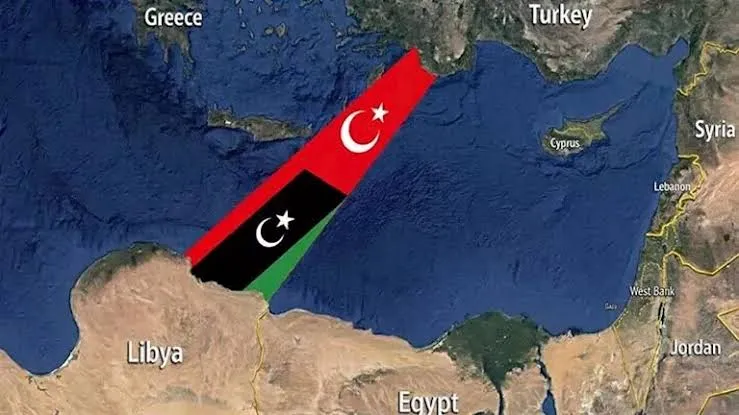
The ratification by Libya's eastern House of Representatives of the maritime memorandum of understanding signed between Turkey and Libya's Government of National Accord in 2019 has reopened the file of competition for maritime influence in the eastern Mediterranean and triggered Israeli, Greek, Egyptian and European reactions, amid fears over the agreement's implications for energy projects, security alliances and maritime navigation routes.
On 20 October this month, the eastern Libyan parliament unanimously approved the memorandum and annulled two decisions issued in 2020 that had rejected the maritime and security agreements with Turkey and decided to cut political relations with Ankara, according to Reuters.
The following day, Israel condemned the move, considering that it affects the sovereign rights of its allies in the region, and again accused Turkey of working to destabilise the eastern Mediterranean, according to The Times of Israel
The impact of the development is not limited to the relationship between Ankara and the eastern Libyan authorities, but is tied to broader disputes over maritime boundary delimitation, the rights of islands and exclusive economic zones, as well as the electricity interconnection project between Greece, Cyprus and Israel, and Turkey's place in regional balances.
From the 2019 agreement to the new Libyan ratification
Turkey and the Government of National Accord in Tripoli signed the maritime boundary delimitation memorandum on 27 November 2019, and the Turkish parliament ratified it in December of the same year, before it entered into force in Turkey. The eastern Libyan authorities rejected the agreement at the time, and Greece and Egypt also opposed it.
The latest ratification represents a shift in the position of the eastern parliament, which had previously rejected the memorandum, after relations between Ankara and Khalifa Haftar's camp saw a rapprochement in recent years. The vote was preceded by the formation of a technical committee to study the agreement in 2025, according to Greek newspaper To Vima.
Saddam Haftar said the agreement represents a tool to protect Libya's rights and economic interests in the Mediterranean, according to Reuters.
On the other hand, Greek newspaper "Proto Thema" reported an account linking the ratification to changes within the Libyan parliament and pressure exerted by Saddam Haftar, including the removal of former parliament speaker Aguila Saleh, who opposed putting the agreement to a vote.
Ankara welcomed the decision and described the memorandum as being based on international law and the principles of equity. Turkish Foreign Minister Hakan Fidan also considered that the Libyan ratification is formal in nature for Turkey, because the agreement is already in force from its point of view Türkiye Today; Reuters.
Greece, Egypt and the European Union: legal and political objection
One of the most prominent points of contention is the interpretation of the international law of the sea, the limits of the maritime rights of the Greek islands, and the extent to which Turkey and Libya are entitled to delimit a maritime zone between them.
The Greek Ministry of Foreign Affairs said the memorandum is «illegal and void», arguing that the two countries do not possess opposite or adjacent coasts that would justify the delimitation contained in it, and that the agreement ignores the rights of the Greek islands to maritime zones under the United Nations Convention on the Law of the Sea. Athens affirmed that it had informed its partners and allies of the decision, and that it would take the necessary measures to protect its sovereign rights.
European Commission President Ursula von der Leyen also expressed regret over the ratification, considering that the agreement infringes on the sovereign rights of other states and is incompatible with the law of the sea, and renewing European solidarity with Greece and Cyprus. A similar position was issued by European Council President António Costa as well.
As for Egypt, it affirmed that the memorandum is void and has no legal effect for it, stressing that it reserves the right to protect its maritime interests. The Egyptian position gains additional importance because of the exclusive economic zone delimitation agreement Cairo signed with Athens in 2020, whose maritime lines conflict with parts of the Turkish–Libyan vision.
In Washington, the newspaper "Israel Hayom" quoted the Greek newspaper «Kathimerini» as saying that the US State Department refrained from issuing a similar condemnation or settling its position on the legality of the agreement and the rights of the Greek islands, which provoked displeasure in Israel, Greece and Egypt, according to the report.
These positions reveal the breadth of the regional dispute, but they do not mean there is an international consensus on a single interpretation of the agreement; Ankara insists on its legality, while Athens, Cairo and the European Union reject it, and the question of its legal effects remains in dispute.
Why does the agreement worry Israel?
The Israeli objection came from the angle of protecting allies, especially Greece and Cyprus, but it is also linked to security and economic concerns that go beyond the bilateral relationship between Turkey and Libya.
The Israeli Foreign Ministry said the agreement infringes on the sovereign rights of its allies, and accused Ankara of seeking to destabilize the eastern Mediterranean, according to the "JNS" network.
This position is not unprecedented; in December 2019, then-Israeli Foreign Minister Israel Katz announced his opposition to the agreement, but ruled out that this opposition would lead to sending warships to confront Turkey, noting that the two sides do not want a direct confrontation, Reuters.
Five main axes of concern stand out in the current Israeli reading:
1- The Israel–Cyprus–Greece electricity interconnection project
The «Great Sea Interconnector» project is one of the most prominent files in which Israeli, Turkish, Greek and Cypriot interests intersect. The project aims to link the electricity grids of Greece, Cyprus and Israel via a submarine cable, strengthening electricity interconnection between the Eastern Mediterranean and Europe.
The planned project is about 1,208 kilometres long, with an estimated cost of around 1.9 billion euros, according to the reports cited in the Associated Press.
The project faced delays, funding disputes and complications linked to maritime disputes before its implementation steps moved forward. In August 2026, the Greek company «ADMIE» submitted an investment request for the section linking Cyprus to Israel, while «Meridiam» joined the consortium responsible for the Greek–Cypriot section, according to "Cyprus Mail".
Israeli analysts fear that the maritime dispute will increase the political and security complications facing the project. But these concerns do not prove that Turkey will prevent the laying of the cable or that the agreement automatically allows it to disrupt it.
2- Navigation security and maritime infrastructure
Israel fears that escalating competition in the Eastern Mediterranean will increase the risks surrounding navigation corridors and electricity and communications cables, especially if energy projects are implemented alongside maritime surveys and competing military movements.
An analysis published by "The Jerusalem Post" quoted Israeli sources expressing fears that the agreement would strengthen Turkey's maritime position, given Israel's heavy reliance on maritime transport to secure its imports.
Israeli reports have also previously spoken of Turkish warships intercepting an Israeli research vessel in Cypriot waters, an incident that reflected the sensitivity of maritime activities in the region.
These facts remain indicators of the level of tension, but they are not sufficient on their own to prove that there is a Turkish decision to target Israeli infrastructure or disrupt its projects.
3- The expansion of Turkey's presence in Libya
The shift in the position of the Libyan parliament in the east adds a new dimension to Turkish–Libyan relations. After years of dispute, Ankara is now in a position that allows it to expand its cooperation with parties that had opposed its maritime agreement, which could strengthen its political, economic and security presence in Libya.
Israeli analyses suggest that combining Turkey's presence in western Libya with its rapprochement with Haftar's camp could give Ankara a wider margin for movement in the central Mediterranean, and heighten the concerns of parties that built relations with eastern Libya in past years.
However, the extent of any actual shift in Turkey's military presence in the east of the country, and whether it will translate into new maritime or aerial arrangements, still requires independent field evidence. The Greek newspaper "Proto Thema" offers a reading that links the ratification to shifting balances inside Libya and to regional competition for influence.
4- The future of the Israeli–Greek–Cypriot alliance
Israel's strategy in the eastern Mediterranean rests on growing security and political relations with Greece and Cyprus, alongside cooperation with Egypt. The three countries—Israel, Greece and Cyprus—held a trilateral summit in Jerusalem in December 2025 focused on strengthening cooperation, according to Greek City Times.
Turkey's rapprochement with eastern Libya would increase pressure on this system, particularly if it leads to expanded Turkish–Libyan cooperation in energy or maritime security.
Israeli analysts warn that any shift in the Egyptian or Emirati position could alter the region's balance calculations. Yet the Libyan parliament's ratification does not mean existing alliances will automatically unravel; rather, it adds a new factor to the network of regional competition.
5- The broader Israeli–Turkish tension
The controversy over the maritime memorandum cannot be separated from the escalating tension between Ankara and Tel Aviv over multiple regional files, including the war on Gaza and influence in Syria and the eastern Mediterranean.
"To Vima" published a report on a document attributed to the Turkish Ministry of Defense discussing the monitoring of Greek and Israeli activities and readiness for possible developments, including military crises.
The Turkish Ministry of Defense also confirmed in September 2026 that it is following military developments in the Aegean Sea and the eastern Mediterranean and taking the measures it deems necessary to protect its interests, according to Daily Sabah.
These statements reflect a level of mutual caution, but they do not constitute evidence that military confrontation has become imminent.
What have developments not yet proven?
Despite the intensity of the reactions, a distinction must be drawn between confirmed facts and security and political assessments.
First, the legal dispute remains unresolved: Greece, Egypt and the European Union reject the agreement or object to its implications, while Turkey stresses its legality. Turkey is also not a party to the United Nations Convention on the Law of the Sea, a factor present in the legal debate but one that does not by itself settle all questions related to maritime boundary delimitation.
Second, nothing in the materials cited proves that Ankara has decided to obstruct the electricity interconnection project. Indeed, retired Israeli Colonel Eran Lerman, vice president of the Jerusalem Institute for Strategy and Security, said he was not certain Turkey would actually intervene to prevent the laying of the cable, though he expected the level of tension to rise in the coming years. The Jerusalem Post, 21 October 2026.
Third, the Libyan ratification does not mean an immediate change on the ground in maritime boundaries or ship movements, although it gives the agreement new political backing from the authorities in eastern Libya.
Finally, a large share of the available analyses comes from Israeli, Greek and Turkish sources, each with its own political and security angle. Estimates about «Israel being encircled» or «the region's stability being undermined» should therefore be treated as characterizations issued by those who make them, not as settled independent facts.
The future of the Eastern Mediterranean: four possible scenarios
Based on the published data, four paths for future developments can be envisaged, with the emphasis that these are analytical possibilities and not confirmed forecasts.
Scenario one: political and legal tension: This is the path the current data allow; Greece, Cyprus, Egypt and the European Union continue to object to the agreement, while Turkey sticks to its position and works to expand cooperation with eastern Libya. At the same time, Israel continues to support its security partnerships with Athens and Nicosia without engaging in a direct confrontation with Ankara.
Scenario two: limited maritime friction: Disputes may increase over marine survey operations, cable routes and naval movements, especially as the electricity interconnection project advances, and coordination measures or objections to maritime activities may turn into tools of political pressure. An opinion article in "Townhall" raises the possibility that Turkey will rely on the memorandum to demand coordination with it over surveying the cable route, but this claim needs official confirmation.
Scenario three: regional repositioning: This path will depend on Ankara's ability to consolidate a long-term partnership with Haftar's camp, and on the positions of Egypt, the UAE and the United States on developments in Libya. Any change in these parties' calculations could alter the balances inside Libya and in the Eastern Mediterranean.
Scenario four: broader military escalation: This possibility remains if a maritime or aerial incident leads to a confrontation between Turkey and Greece or Cyprus and then spreads to other parties. However, the cost of confrontation for those involved, and the membership of Turkey and Greece in NATO, make broad escalation an undecided path, and the available data do not allow it to be regarded as a definitively likely outcome.
Indicators worth following
The significance of the agreement will be determined in the coming phase through a set of developments, most notably:
- Legally:: Any new moves at the United Nations, and the course of negotiations on the maritime border demarcation between Libya and Greece.
- On the Libyan side:: The extent of the stability of the parliament's leadership in the east, the position of the Tripoli government, and any new steps in Turkish cooperation with Libyan parties.
- Maritime:: The movements of survey and research vessels, and any dispute over cable routes or maritime activities south of Crete.
- Economically:: Financing decisions and timelines for the electrical interconnection project, and the positions of the relevant European and American bodies.
- Politically and security-wise:: The development of Turkish–Israeli relations, and the limits of coordination between Egypt, the UAE, Greece, Cyprus and Israel.
Summary
The implications of the Libyan ratification go beyond the maritime agreement itself, because it reflects a shift in the position of the authorities in eastern Libya and opens the way for broadening Turkish–Libyan cooperation, in a region where maritime border disputes overlap with energy projects and security alliances.
Israeli concerns stem from the possibility that this development could affect navigation security, the electrical interconnection project and the balance of influence in the eastern Mediterranean, but they remain concerns and assessments that do not establish that the agreement will inevitably lead to disrupting energy projects or to a military confrontation.
As for the most important track in the coming phase, it lies in how political ratification is translated into practical steps: Will the Turkish partnership with eastern Libya expand? Will energy projects proceed despite the objections? And how will the relevant parties deal with the legal and maritime disputes?
The answers to these questions will determine whether the region will remain within the framework of political and legal tension, or will witness sharper maritime frictions, while a broad military confrontation remains a possibility that cannot be asserted on the basis of the current data.