
Mohammed Mushainesh: we reject token elections and demand real representation in the National Council
Mohammed Mushainesh, head of the Conference of Palestinians in Türkiye, affirms support for free and transparent National Council elections and calls for guaranteeing the participation of Palestinians at home and in the diaspora and rejecting appointment mechanisms.
FiMED – Follow-up
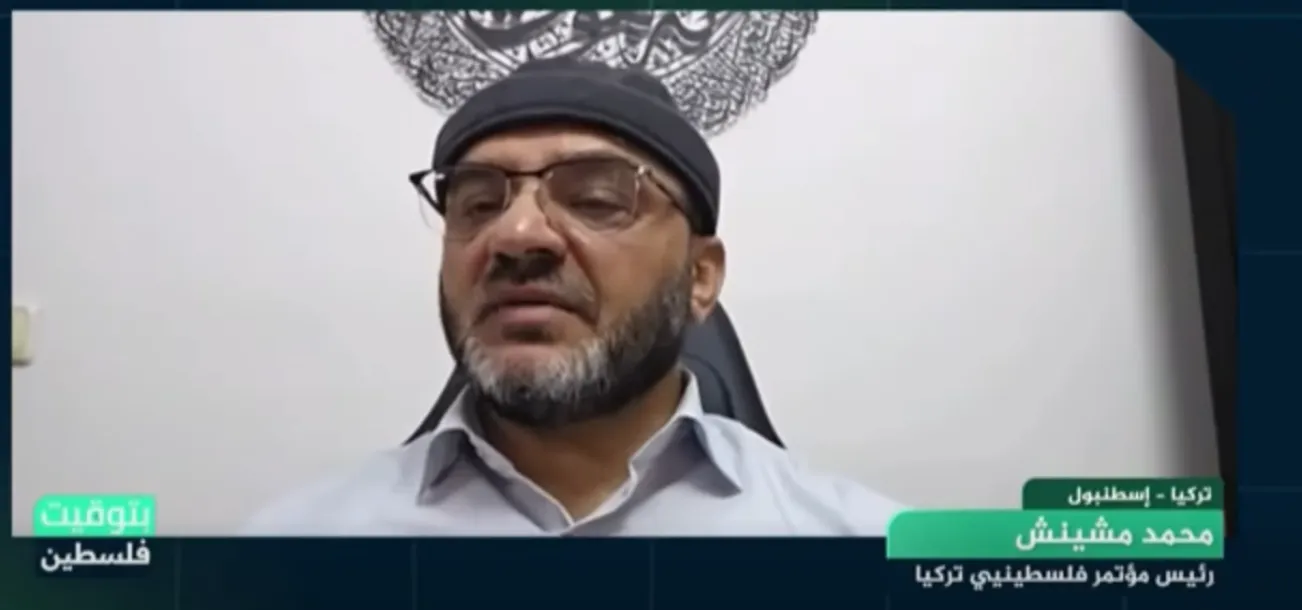
The programme "On Palestine Time" on Misk TV hosted Mohammed Mushainesh, head of the Conference of Palestinians in Türkiye, in an episode discussing the crisis of Palestinian representation and the controversy over the mechanisms for reconstituting the Palestinian National Council, particularly direct elections, electoral colleges and appointments in diaspora countries.
Mushainesh said the position of the Conference of Palestinians in Türkiye is based on supporting free, fair and transparent elections, stressing that elections are, as he put it, an inherent right of Palestinians to choose their representatives, and not a means of renewing the legitimacy of institutions through selective mechanisms.
He explained that the problem lies not with the principle of reconstituting the National Council but with the mechanisms for selecting its members, pointing to the need for a clear legal framework regulating the relationship between voters, candidates and the elections commission, as well as guaranteed independent oversight and transparency in voter registration and the announcement of results.
Mushainesh criticised what he described as reliance on electoral colleges formed selectively in some diaspora countries, questioning the criteria used to decide that direct elections cannot be held and who decides to switch from elections to electoral colleges.
He added that the Conference of Palestinians in Türkiye does not reject the principle of electoral colleges in countries where direct elections cannot be held, but, according to its position, requires that they include national action institutions and civil society, and that they operate under the supervision of an independent and neutral commission and in line with a clear electoral law.
Representation of Palestinians abroad
Mushainesh linked the crisis of representation of Palestinians abroad to developments after the Oslo Accords, arguing that, in his view, the shift of the centre of political action to the Palestinian territories led to a decline in the diaspora's participation in national decision-making.
He noted that the Popular Conference for Palestinians Abroad was founded in 2017 to strengthen the participation of Palestinians living outside the Palestinian territories in political life, stressing that, in his vision, rebuilding national institutions must include Palestinians at home and in the diaspora.
As for Türkiye, Mushainesh said Palestinians there are able to take part in direct elections to choose their representatives, noting that the Conference of Palestinians Abroad held a workshop in 2020 that examined the possibility of holding Palestinian elections in diaspora countries and, as he put it, set out proposals and mechanisms for doing so.
Refusing to turn the exception into the rule
Mushainesh stressed that resorting to electoral colleges or consensus arrangements must not become a permanent substitute for direct elections, arguing that any alternative formula must be based on clear criteria and must not exclude Palestinian components from the selection process.
He said that if elections cannot be held and an electoral college capable of representing the various components cannot be formed, consensus should be inclusive and not limited to a pre-selected group.
A call for dialogue
At the end of the interview, Mushainesh affirmed the readiness of the Conference of Palestinians in Türkiye for dialogue with the Authority, the factions and Palestinian institutions to reach a shared electoral formula, denying that the aim was to enter into an open political confrontation. He said the conference prefers dialogue and national consensus, arguing that internal differences should not turn into a confrontation among Palestinians, given the challenges facing the Palestinian cause.