
Israeli society three years after 7 October: exhaustion, polarisation and crises threatening its cohesion
Three years after the 7 October war, Israel faces deepening psychological, economic and political crises, rising emigration and internal polarisation that threatens the cohesion of society.
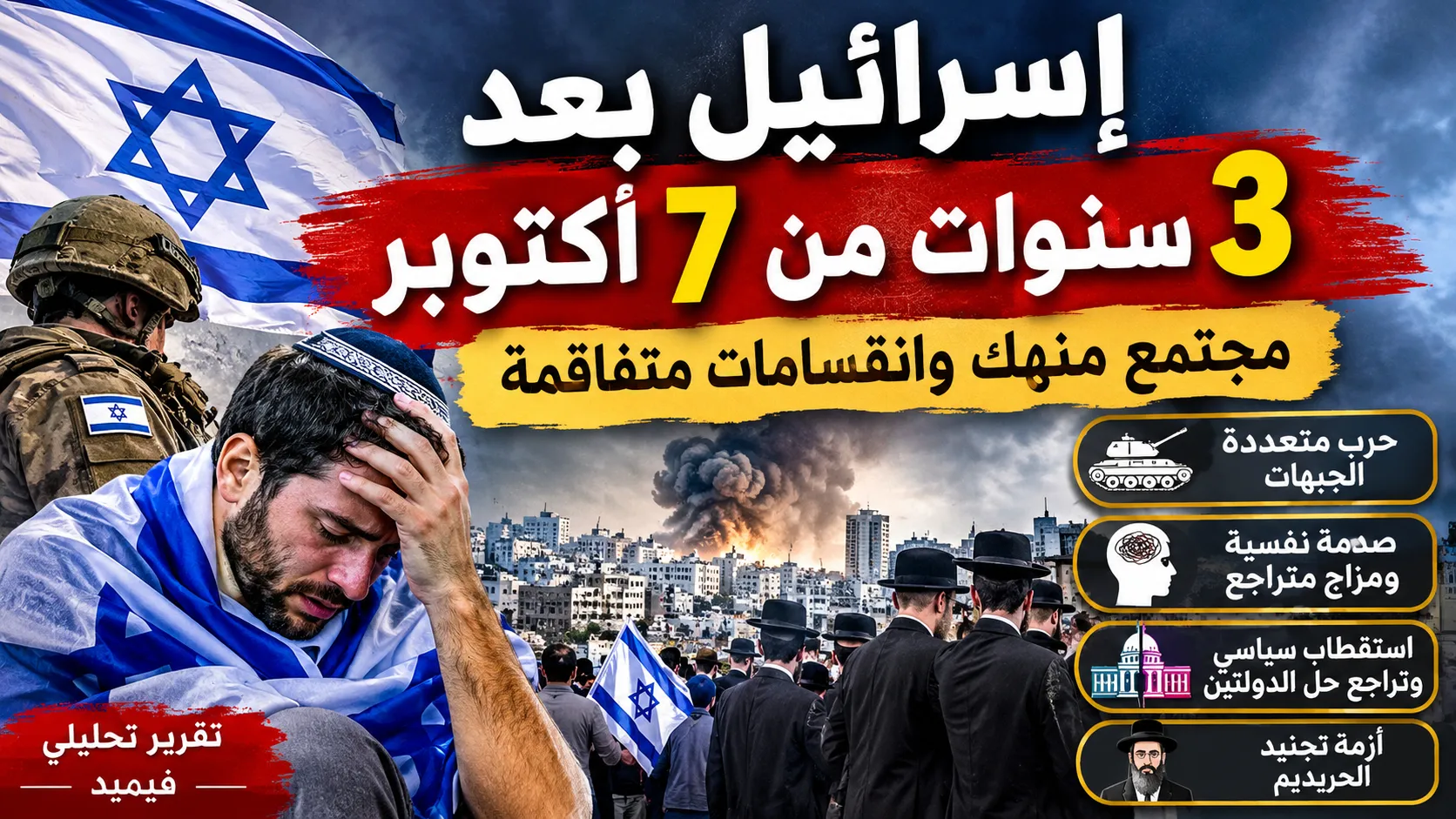
Analytical report - FiMED
The events of 7 October 2023 are no longer merely a pivotal security and military juncture in Israel's history; they have become a turning point in the trajectory of Israeli society, which now views its modern history as two phases: before 7 October and after it.
Over three years, Israel has witnessed a multi-front war extending from the Gaza Strip to Lebanon and Syria, and on to the confrontation with Iran, accompanied by profound shifts in the public mood, escalating political polarisation and deepening disputes over compulsory conscription and the relationship between religion and state, alongside a continuing crisis between the government and the judiciary.
At the same time, Israeli society has faced growing psychological and economic repercussions, rising emigration rates and worsening criminal violence within the Arab community, while the elections of 27 October 2026 revealed the persistence of political division and the inability of the main camps to settle the formation of a government.
Most of the readings addressed in this report indicate that the events of 7 October did not create the divisions within Israeli society, but accelerated their emergence and deepened them, pushing many old disputes to the forefront of the political and social scene.
First: Three years of war and a shifting public mood
The attacks of 7 October 2023 caused widespread shock inside Israel, after about 1,200 people were killed, according to figures circulating in Israeli reports. On the other hand, the number of Palestinian martyrs in the Gaza Strip has exceeded 74,000 since the start of the war, according to data contained in Palestinian sources.
As the confrontation extended to multiple fronts, the war was no longer a limited military event but became a factor affecting Israelis' daily lives, through periods of bombardment and resort to shelters, the call-up of reserve forces, and a decline in the sense of security and stability.
According to the Israeli Society Index issued by the Jewish People Policy Institute (JPPI) in October 2026, about four in ten Israelis believed their country had won the war, a slightly lower proportion than the previous year. This reflects a gap between the military outcome cited by Israeli institutions and the assessment by segments of the public of the war's results and costs.
Second: Psychological shock.. an open home front
Psychological repercussions are among the most prominent effects of the war on Israeli society; reports have indicated a marked rise in children's visits to psychiatric emergency departments, with increasing cases of post-traumatic stress disorder among younger age groups.
On 6 October 2026, the Israeli Ministry of Defense announced that about 30,000 soldiers and security personnel had been received in the rehabilitation department since the outbreak of the war, and that 63% of the injured suffer psychological repercussions, including post-traumatic stress disorder, anxiety, depression and difficulties returning to civilian life. According to ministry data, the number of those receiving treatment in the department from various wars and military operations reached 91,200 people, including 42,500 suffering from psychological disorders or post-war trauma.
At the level of public mood, 61% of Israelis said in a poll by the Israel Democracy Institute that national morale was bad, with a higher rate recorded among Jews compared with Arabs. The institute's pre-election poll showed that 61% of the public described the national mood as bad, including 65.5% of Jews and 40% of Arabs.
The October 7 attacks had unleashed a wave of internal solidarity that temporarily eased the intensity of political and social disputes, but this cohesion did not last long. According to assessments by the Institute for National Security Studies (INSS), divisions linked to identity and governance returned to the fore, while participants in a July 2026 poll ranked violent conflict between segments of society among the most prominent threats facing Israel.
Nor did the war lead to a broad and sustained religious shift; the Israeli Society Index of the JPPI indicated that the share of Jews who said they had become more observant in prayer since the war fell from about one-third to roughly one-fifth.
Third: Political polarization.. a shift to the right or a deepening of divisions?
Opinion polls showed that the war pushed a segment of Israeli society to adopt more right-wing positions, but it did not necessarily lead to a collective transfer between political camps.
According to data from the Jewish People Policy Institute, 33% of Jewish respondents said they had moved toward the right since the war, compared with 14% who said they had moved toward the left, while 54% confirmed that they had not changed their political positions. These indicators are reported in the Israeli Society Index of the JPPI.
On the two-state solution, the Peace Index issued by Tel Aviv University in July 2026 showed that support for the two-state solution reached 24% among Jewish respondents, compared with 71% among Arab respondents. These figures reveal a wide gap in positions between the two groups, and also reflect the continued decline in the prospects for a political settlement in Israeli public opinion.
Researchers believe that this decline did not begin with the war, but was preceded by political and social trends that helped entrench positions rejecting a settlement, while others believe that the war reinforced this tendency, especially among young people.
In contrast, researcher Tamar Hermann of the Israel Democracy Institute believes that the events of the war pushed many Israelis deeper into their original political camps rather than moving them from one camp to another; new information regarding the government's responsibility for the October 7 failure is now often interpreted through pre-existing political positions.
Despite the division, polls showed broad support for some reform demands, including limiting the number of a prime minister's terms to 63%, pursuing a constitution to 59%, and forming an official commission of inquiry into the October 7 failures to 58%, according to the indicators in the JPPI report.
Fourth: The Haredi conscription crisis.. a struggle over burden-sharing
The issue of Haredi Jewish conscription has become one of the most sensitive files of internal dispute, after religious and political considerations became intertwined with the military and economic pressures imposed by the war.
After the conscription exemption law expired in 2023, the Supreme Court ruled that the army must begin Haredi conscription procedures, and the authorities began taking legal measures against draft evaders.
During 2026, Israel witnessed repeated protests by Haredim, including the closure of main roads, confrontations with police, and demonstrations in front of conscription centers and military prisons.
In July 2026, the Knesset approved a law that temporarily suspends the arrest of draft evaders, before the Supreme Court issued an interim order on July 15 barring the law from taking effect until a further ruling is made. The Israel Democracy Institute explains the background to the law and its implications, and The Times of Israel also covered the court's ruling.
The issue goes beyond military service to a broader dispute over fairness in the distribution of burdens; as reservists continue to be called up and fronts multiply, criticism of the exemptions granted to the Haredim is mounting, while supporters of these exemptions argue that Torah study represents a religious and national value, and that imposing service and criminal sanctions on those who refuse it constitutes an infringement on their way of life.
The Bank of Israel warned that the proposed bill would not ease the burden on reservists, reflecting the persistent gap between the army's needs and the political calculations of the ruling coalition.
Fifth: The judiciary and democracy.. an unfinished confrontation
The confrontation between the government and the judicial establishment in Israel has continued over the past three years, making it one of the most prominent sources of internal polarization.
In March 2025, the Knesset approved a law changing the composition of the Judicial Selection Committee in a way that gives the government coalition greater influence in the appointment process.
In August of the same year, the government voted to dismiss the Attorney General, Gali Baharav-Miara, but the Supreme Court annulled the decision on December 14, 2025.
The confrontation escalated again in June 2026, when Supreme Court President Isaac Amit and the Attorney General warned that the coalition's steps threaten the structure of the democratic system, while supporters of the changes defend their position as an attempt to curb what they describe as judicial overreach and to strengthen the powers of elected institutions.
After the October 2026 elections, the Religious Zionist Party announced plans to carry out broader judicial changes, including splitting the position of Attorney General.
These developments reveal that the dispute is no longer limited to specific legal amendments, but now revolves around the nature of the political system and the limits of the powers of the government and the Supreme Court, which makes this file one of the most prominent sources of tension in the coming phase.
The 2025 Israeli Democracy Index study addresses the continued tension between political camps and the decline in trust in government institutions, alongside a drop in public assessments of social solidarity.
Sixth: Migration and demography.. a growing number of departures
In recent years, Israel has witnessed a rise in the number of people leaving, amid escalating debate over the impact of the war and political and economic conditions on migration decisions.
According to a Tel Aviv University study based on data from the Central Bureau of Statistics, the number of people who left Israel for three consecutive months or more reached 86,509 in 2023, 91,499 in 2024, and 90,922 in 2025, totaling 268,509 people over three years.
The comparison indicates that this figure is higher than in the 2013–2015 period, which recorded the departure of 183,219 people according to the same criterion. Tel Aviv University published the details of the study in its report on the continued high levels of emigration from Israel, and the economic newspaper Globes.
At the end of 2025, Israel's population stood at about 10.178 million, with a growth rate of 0.9%, the lowest in history according to the Taub Center. The figure rose to about 10.244 million in April 2026.
These figures raise economic concerns about the emigration of skilled professionals, especially since those leaving, according to economic analyses, have higher-than-average levels of education and income.
A survey by the Israel Democracy Institute also showed that 39% of secular Jews are thinking about leaving Israel, compared with lower rates among religious and Haredi groups. These results appear in the institute's study titled "Stay or Leave?", which examined the motivations behind considering emigration and the factors influencing it.
Seventh: The Economy.. The War Bill Presses on Society
The cost of the war was not limited to human and military losses, but extended to the Israeli economy, which bore the burdens of military spending, reserve call-ups and a decline in activity across various sectors.
The Governor of the Bank of Israel estimated the cost of the conflicts linked to the events of October 7 at about 405 billion shekels, equivalent to 138 billion dollars, up to late April 2026, according to Agence France-Presse in a report on the economic and social cost of the war.
In the first quarter of 2026, the economy contracted at an annual rate of 3.3%, affected by the confrontation with Iran, despite the Bank of Israel's forecasts of growth of about 4% during the same year.
The estimates of the Bank of Israel in its annual report for 2025 indicate that the financial cost of the war reached about 350 billion shekels during the years 2023–2026, according to an estimate that excludes decisions taken after the start of the «Roaring Lion» operation against Iran. This figure differs from the estimate of 405 billion shekels, which covers a broader range of conflicts and costs.
The high cost of living stands out as one of the most important sources of social concern; a survey by the Israel Democracy Institute showed that 38% of Jews and 46% of Arabs place it among their economic and political priorities. Al Jazeera, in its report on the Israeli economy ahead of the October 2026 elections cited these results, based on the institute's survey.
In this context, reports by the Latet association spoke of the emergence of a category it described as the «war poor», namely individuals and families working full time whose incomes are nonetheless insufficient to cover the minimum living requirements. The child poverty rate also reached about 28% in 2024, according to National Insurance data.
By contrast, the Bank of Israel points out that wages have risen faster than prices, which creates a discrepancy between macroeconomic indicators and the sense among segments of society that the cost of living has risen and their purchasing power has declined.
Eighth: Arab society.. crime and eroding trust
Arab society inside Israel faces a deepening crisis due to the escalation of murders and organized violence, amid continuous criticism of the police and the government over their handling of this phenomenon.
The year 2025 was the deadliest, with 252 people recorded killed in criminal violence, while reports indicated that murder rates continued to rise during 2026.
Data reported by CNN in a report on the spread of crime in Arab towns indicates that the Israeli police solved only about 15% of murders in Arab society, compared with about 65% in Jewish society, based on data from the Knesset and the "Ilaf" Center for Strengthening Security in Arab Society.
The Financial Times also documented in its report on violence linked to organized crime the rise of gangs' influence and extortion, and the growing sense of insecurity among residents, amid criticism of government and police policies.
Arab leaders accuse the police and the government of failing to confront organized crime, while the continuation of violence reflects eroding trust in state institutions and their ability to provide security for Arab citizens.
On the political level, the October 2026 elections witnessed a significant rise in Arab participation, and the Arab parties, namely the "Joint List" and "Ra'am", won a total of 19 seats, according to the final results published on the official website of the Israeli Knesset.
Despite political and social tensions, studies confirm that Arab citizens inside Israel record higher levels of support for the two-state solution compared with wide segments of Jewish society; Tel Aviv University's Peace Index in July 2026 showed support for the solution at 71% among Arab respondents, compared with 24% among Jews.
Ninth: The October 2026 elections.. a parliament without a governing majority
The Knesset elections held on October 27, 2026 reflected the continuation of political division, after the main blocs failed to secure the majority needed to form a stable government.
The elections recorded the highest turnout since 1999, but their results did not give any of the camps the ability to form a government on its own.
According to the final results, Benjamin Netanyahu's bloc won 53 seats, compared with 48 seats for the opposition bloc, while the Arab lists won 19 seats. The Likud party remained the largest party with 27 seats, while the "Yashar" party led by Gadi Eisenkot won 21 seats, and the "Bayahad" party led by Naftali Bennett won 12 seats.
The official results published on the Knesset website show the distribution of seats among the winning lists, while The Times of Israel reported their distribution among the political blocs: 53 for Netanyahu's bloc, 48 for the opposition, and 19 for the Arab lists.
With no bloc holding 61 seats, the options for forming a government remained open to complex political negotiations, or the possibility of going to new elections.
The members of the new Knesset are scheduled to be sworn in on November 10, amid warnings about the danger of casting doubt on the integrity of the electoral process. The chairman of the Central Elections Committee had described questioning the results as a real danger to democracy, stressing that no evidence of any breach of the elections' integrity had been found.
Tenth: How do Israelis read the results of the war?
Israeli, Palestinian and international readings of the war's repercussions and outcomes vary, and there is no single interpretation that enjoys the consensus of the different parties.
The Israeli reading and research centers: Some Israeli analyses hold that Israel emerged from the war with greater military and strategic capabilities than it had before October 7, but that it has become more exposed to the costs of long wars, more dependent on American support, and more isolated in parts of Europe. This reading appears in analyses by Israeli newspapers and research centers, including the Institute for National Security Studies.
The critical Palestinian and human rights reading: Palestinian and international human rights bodies describe the war on Gaza as genocide, and argue that the past three years have witnessed an escalation in violence and control over Palestinians, and a change in discourse and positions within Israeli society. The Israeli government opposes this characterization, and many inside Israel reject it as well.
The social and political reading: It focuses on the fact that the divisions over the judiciary, religion and state, and identity existed before the war, particularly during the judicial overhaul crisis of 2023. According to this interpretation, the war did not overturn the political map so much as temporarily freeze some of its disputes, before they returned in a sharper form. The 2025 Israeli Democracy Index study addresses the persistence of tensions between political camps and the decline in trust in institutions.
Eleventh: The map of divisions.. which is the most influential?
The 2025 Democracy Index issued by the Israel Democracy Institute showed that the divide between right and left topped the sources of tension within society, followed by tensions between Jews and Arabs, and between religious and secular Israelis.
Among Arab respondents, the tension between Jews and Arabs ranked first, followed by the divide between political camps. The results of the 2025 Israeli Democracy Index provide further details on internal tensions and levels of trust and social solidarity.
These divisions do not operate separately; the crisis over the exemption of Haredim from military service overlaps with political alignments, and the opposition to the government includes various segments, among them secular Israelis, reservists, and immigrants from the former Soviet Union.
Polarization also extends to freedom of expression; the Israel Democracy Institute found that a significant segment of the public is reticent about expressing its political views in front of those who disagree with it, and that about a third of Israelis oppose discussing the war and political issues in classrooms.
Right and left.. more rigid affiliations
Several polls have shown that the war deepened existing political affiliations more than it produced a broad shift between right and left. Political science professor Gideon Rahat describes Israeli politics as highly polarized, personalized and populist, and centered on identity.
Among the most prominent manifestations of this division is the dispute over responsibility for the October 7 failure; the opposition holds Netanyahu responsible for the security failure, while his supporters see the demand for an independent investigation as being used within the framework of political conflict.
Despite that, JPPI polls showed that 58% support forming an official commission of inquiry, while the government decided to form its own committee, which faces criticism from its opponents who see that it does not guarantee the independence of the investigation.
The war with Iran, which was given the name «Roar of the Lion» operation in February 2026, also showed broad support among Israeli Jews of various affiliations, though less so on the left, compared with greater skepticism among Arab citizens.
Religion and state.. conscription at the heart of the conflict
The issue of Haredi conscription has turned into a symbol of a broader conflict over the relationship between religion and state, and the distribution of burdens among segments of society.
The country witnessed Haredi protests during which main roads were closed, in return for protests by local residents, and confrontations with police also occurred, including clashes in Bnei Brak on February 15, 2026, following an assault on two female soldiers.
This crisis overlaps with issues of equality and the participation of women in the army and the public sphere. While supporters of the exemption consider Torah study a religious and national value, opponents see that the continuation of exemptions grants one segment of society an unfair privilege, while regular soldiers and reserve forces bear the largest part of the burdens.
The crisis has more than once threatened the stability of the government coalition and the budget, while polls in 2026 showed a decline in some indicators of support for the right.
A poll by the Israel Democracy Institute also showed that 39% of secular Jews are thinking about emigration, a higher rate than among religious groups, according to the institute's study on Israelis who are thinking about moving abroad.
Jews and Arabs.. declining trust despite the absence of internal explosion
Despite expectations that prevailed after October 7 of a wide outbreak of internal confrontations between Jews and Arabs, the May 2021 scenario was not repeated in the way many expected.
Data from the Institute for National Security Studies showed that about 90% of Jews and 70% of Arabs expected severe internal violence to erupt, but this scenario did not materialize in the expected form.
However, the absence of wide confrontations did not prevent a decline in mutual trust. In a poll by the Givat Haviva organization, 72% of Jews said they do not trust most Arab citizens, while 43% of Arabs said they do not trust most Jews.
In an earlier poll published in January 2024, 77% of Jews and 62% of Arabs said their sense of personal security had declined.
The Israel Democracy Institute also found that only about a third of Arab citizens feel safe inside Israel, while about three-quarters of Jews said living in Israel is safer for Jews. The polls also showed a clear gap in trust in the military narrative; most Arabs do not believe the army tries to avoid harming civilians, compared with 78% of Jews who believe it does.
The dispute extended to freedom of expression, with rights organizations, including the Adalah center, documenting cases of arrest and dismissal from study or work over posts related to the war in Gaza. Estimates of the number of Arabs detained during the first weeks of the war varied from dozens to more than 170 people, depending on the source and the period covered.
On the other hand, Israeli authorities argue that some measures were necessary during the war to prevent incitement.
On the domestic level, a Konrad Adenauer program poll showed that 54% of Arabs consider combating crime a priority that comes ahead of the Palestinian issue, which may explain part of the rise in their participation in the 2026 elections.
The integration of Arab parties into the government is still rejected by a large Jewish majority, while the election results gave the Arab parties 19 seats that made them an influential factor in the calculations of forming a government, without joining either of the two main blocs.
Reserve soldiers.. the burden of war turns into social dispute
The continued call-up of reserve forces and the multiplicity of combat fronts led to disparities emerging between the soldiers who bear the burdens of military service and other segments of society.
Reserve soldiers spoke of exhaustion, professional losses, and family and economic pressures, while economic reports indicated that the reserve call-up puts pressure on small companies and the liberal professions and affects the stability of the labor market.
The dispute is no longer confined to political or ideological positions, but has extended to a practical question related to the distribution of the burdens and costs of the war among the components of society.
Generation and class.. widening gaps under the pressure of war
Analyses indicated that a segment of Israeli youth moved toward more right-wing positions after October 7, while a poll by the Israel Democracy Institute covering the 18-22 age group in May 2026 showed differences between Jews, Arabs and the religious in patterns of political participation and sources of influence.
The poll showed greater reliance among Arab youth on social media, compared with a stronger influence of the family in shaping the political positions of religious youth.
On the economic level, class disparities intersect with disputes over Haredi budgets and military spending, amid the emergence of groups that the Latet association describes as the "war poor," namely workers whose incomes are not enough to cover basic needs.
Twelfth: What actually changed? And what remained as it was?
A comparison between before and after October 7 reveals that Israeli society did not witness a unified radical shift in one direction, as much as it witnessed a deepening of previous divisions and the emergence of new crises linked to the costs of the war and its prolongation.
The crisis of the judiciary, religion, state and identity was present before the war, but the security shock, psychological exhaustion and multiplicity of fronts made political and social settlements more difficult.
On the other hand, a group of researchers argue that the core social cohesion has not collapsed, and that a majority of Jews and Arabs still prefer to remain in Israel and feel varying degrees of belonging, despite declining trust in institutions and rising tensions. The October 2026 elections also recorded a high turnout of about 77.9% of eligible voters, according to the results published by the Israeli Central Elections Committee.
In this context, a gap stands out between the continuation of political participation on the one hand, and the decline in mutual trust between the components of society and official institutions on the other.
Conclusions and open questions
The indicators addressed in the report show that Israeli society has become more psychologically and economically exhausted, and more preoccupied with security issues, while political and social polarization continues without necessarily leading to a complete reshaping of political loyalties.
The most prominent fault lines lie in four interconnected files: Haredi conscription and sharing the military burden, the clash between the government and the judiciary, the relationship between Jews and Arabs, and the gap between reservists and the rest of society.
The next phase raises a set of questions that will determine Israel's internal course: Will the political blocs succeed in forming a stable government? Is the country heading toward new elections? How will the next government deal with the conscription crisis and the judicial amendments? Will the wave of emigration continue, or recede as security and economic conditions improve? And will the high Arab participation in the elections translate into actual influence on government policies and decisions?
In sum, the war did not end the divisions inside Israel, but made them clearer and more intertwined, and turned many of the disputes that had revolved around identity, power and religion into crises directly linked to security, the economy, and the future of the state and society.