
9,518 Demolition and Stop-Build Notices Since 2015: Hebron Tops the List as Restrictions Hit Communities
The Wall and Settlement Resistance Commission documents 9,518 demolition and stop-build notices from 2015 through September 2026, including 2,697 in Hebron, amid restrictions on Palestinian construction.
Jerusalem - FiMED
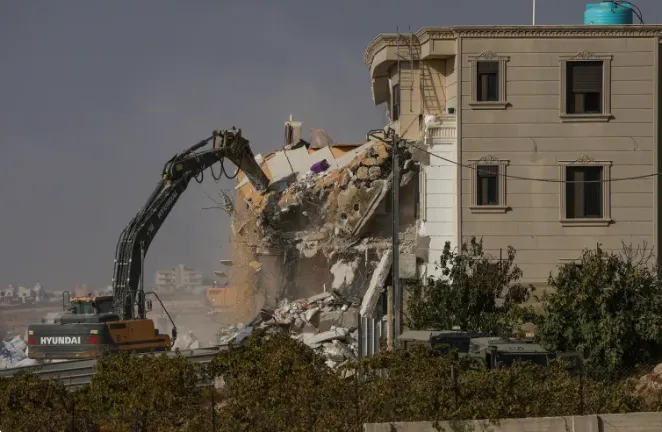
The Palestinian Wall and Settlement Resistance Commission has revealed that it documented 9,518 demolition and stop-build notices in the Palestinian territories from 2015 through the end of September 2026, with Hebron Governorate topping the list with 2,697 notices, followed by Bethlehem with 1,310, Ramallah and Al-Bireh with 1,118, and Jerusalem with 929.
According to a report published by the Commission, the tally included 9,174 notices between 2015 and 2025, in addition to 344 notices during the first nine months of 2026, based on the Commission's data and that of partner legal institutions.
The Commission cautioned that these figures do not necessarily represent all notices issued by the Israeli occupation authorities, nor do they mean that every notice concerns a separate structure, as multiple measures may be taken against a single building. It affirmed that the 2026 data are partial and end on 30 September.
2023 records the highest annual tally
The data show a marked rise in demolition and stop-build notices in recent years; the number climbed from 701 notices in 2015 to 1,333 in 2023, an increase of about 90.2%, before declining to 939 notices in 2024, then rising again to 991 notices in 2025.
Between 2023 and 2025, the governorates of Hebron, Bethlehem, Ramallah and Al-Bireh, and Jerusalem recorded 1,992 notices out of 3,263, or about 61% of all notices during those years.
The number of notices in Ramallah and Al-Bireh Governorate also rose from 83 in 2023 to 169 in 2025, indicating the expanding scope of measures targeting Palestinian construction in the governorate.
In details for 2025, the Commission documented 615 stop-work notices, 227 demolition orders, and 120 notices granting structure owners an additional opportunity, alongside other measures.
Notices extend beyond buildings to family stability
The effects of demolition and stop-build notices are not limited to the possible removal of homes and structures, but extend to disrupting construction and urban expansion, threatening family stability, and undermining the ability of Palestinian communities to develop their facilities and sources of livelihood.
The Commission noted that these measures coincide in several Palestinian areas with land confiscation, road closures, and restrictions on access to grazing lands and water sources, increasing pressure on residents, especially in Masafer Yatta, southern Hebron, the surroundings of Jerusalem and Bethlehem, the Jordan Valley, and areas of Ramallah.
Hebron stands out at the top of the governorates in terms of the number of notices, followed by Bethlehem, Ramallah and Al-Bireh, and Jerusalem, areas experiencing multiple forms of restrictions on construction, planning, and land use.
The planning system since the 1967 occupation
The Commission attributed part of the Palestinian construction crisis to the planning and legal system imposed by the occupation authorities after 1967, through military orders that reorganized planning and decision-making powers in the West Bank.
It stated that Military Order No. 418 of 1971 marked a fundamental turning point in concentrating planning powers in the hands of a higher planning council led by the military establishment, while reducing Palestinian participation in planning processes, before this approach continued with the establishment of the Israeli Civil Administration in 1981.
According to the Commission, the United Nations Office for the Coordination of Humanitarian Affairs (OCHA), based on Israeli Civil Administration data, documented that less than 4% of Palestinian permit applications in Area C were approved between 2015 and 2019, reflecting the restrictions imposed on Palestinian construction in this area, including land owned by Palestinians.
It also referred to Military Order No. 1797 issued in 2018, which began being applied in July 2019, and which provided a shortened track for removing certain structures that the occupation authorities classify as unlicensed in Area «C», according to specific conditions and procedures.
It explained that this track includes a short procedural deadline, essentially 96 hours under the notification and cancellation-request procedures, but that this does not mean demolition is carried out automatically once the deadline expires.
As for East Jerusalem, the occupation authorities apply their own planning and building system, and use demolition orders and fines against owners of homes and facilities, according to what the Commission reported.
It stressed the need to distinguish between demolition on the pretext of building violations, punitive demolition, and destruction that occurs during military operations, given the differing legal bases and procedures associated with each case.
International law places restrictions on the demolition of property
On the legal level, the Commission affirmed that the issuance of a demolition notice based on a military order does not automatically grant it legitimacy under international law, citing rules governing the obligations of an occupying power toward the population and property in occupied territories.
Article 53 of the Fourth Geneva Convention prohibits the destruction of private and public property in occupied territories, except in cases where military necessity requires it in a specific manner, while Article 43 of the Hague Regulations stipulates the obligations of the occupying power regarding the administration of the territory and respect for existing laws, unless absolutely prevented from doing so.
Article 11 of the International Covenant on Economic, Social and Cultural Rights also stipulates the right to an adequate standard of living, including adequate housing.
In its advisory opinion issued on 19 July 2024, the International Court of Justice addressed Israeli policies and practices in the occupied Palestinian territories, including restrictions on construction and demolition and discriminatory treatment, as part of its assessment of the extent to which the continued Israeli presence is consistent with international law.
The data of the Wall and Settlement Resistance Commission highlight the broad scope of demolition and construction-stop notices over more than a decade, and their concentration in a number of West Bank governorates, at a time when planning restrictions and access to land and water remain among the most prominent challenges facing Palestinian communities.