
After the ceasefire in Gaza: Israeli restrictions and destruction block displaced residents from returning
A report examines the main obstacles to the return of displaced people to Gaza, from Israeli access restrictions and widespread destruction to the stalled transitional administration and the reconstruction funding gap.
Special report – FiMED
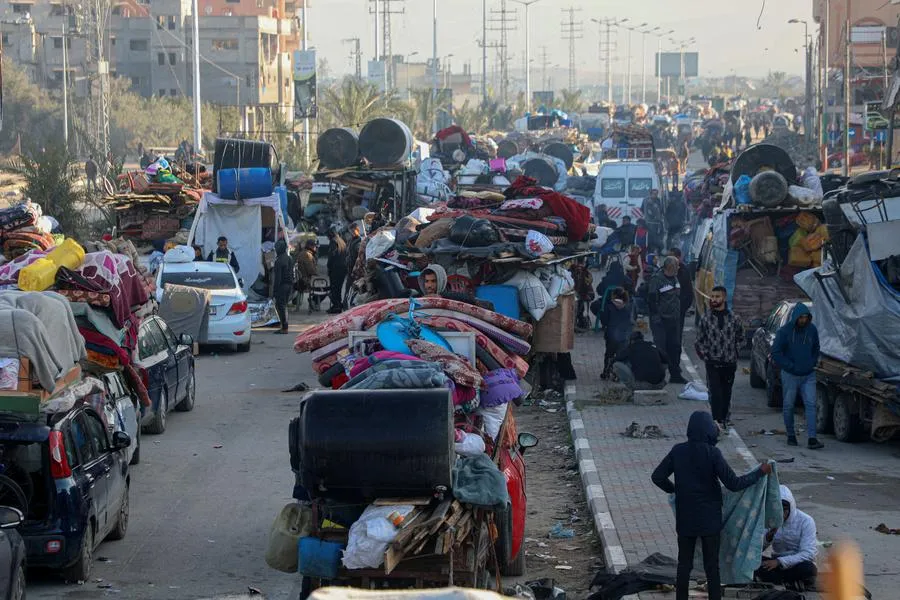
The suffering of displaced Palestinians in the Gaza Strip does not end with the loss of homes and livelihoods; their return to their areas runs into a series of obstacles, most notably Israeli restrictions on access to large swathes of the Strip, the continuation of destruction, the faltering entry of construction materials, and the failure of the Palestinian transitional administration to begin operating inside Gaza.
A fact sheet published by Quds Press on 14 October 2026 shows that the return of residents is not linked to the cessation of military operations alone, but requires field, administrative and humanitarian changes that allow Palestinians to reach their areas, repair their homes and restore basic services.
The Yellow Line and access restrictions
The data in the fact sheet indicate that the area covered by the line known as the “Yellow Line” comprises about 53% of the Gaza Strip, while a UN report issued in September 2026 stated that about two-thirds of the Strip remains inaccessible to Palestinians or is subject to severe access restrictions.
These restrictions limit the ability of displaced people to return to their areas, even when some homes are repairable, and also obstruct access to land, livelihoods and basic services.
The fact sheet stresses the need to distinguish between the area of regions to which access is restricted and the scale of actual military deployment; the figures cited reflect the scope of the restrictions and do not necessarily mean that Israeli forces are deployed on the ground across all of those areas.
Widespread destruction makes return more complicated
Data from the UN Satellite Centre, up to 16 June 2026, show that 201,290 facilities were damaged, equivalent to 82% of the Strip’s facilities.
According to the data in the fact sheet, the damage includes:
- 134 thousand and 422 facilities completely destroyed.
- 13 thousand and 848 facilities severely damaged.
- 28 thousand and 96 facilities moderately damaged.
- 24 thousand and 924 facilities possibly damaged.
The number of damaged housing units was also estimated at about 328,627, leaving large numbers of families with limited options: either staying in displacement sites or returning to areas that lack habitable housing and essential services.
The requirements for return are not limited to rebuilding homes; they include removing rubble and hazards, rehabilitating water, sanitation and electricity networks, restarting health facilities, and ensuring that residents can reach the neighbourhoods from which they were displaced.
1.9 million displaced and services below needs
The fact sheet estimates the population of the Gaza Strip at about 2.1 million, including nearly 1.9 million people who have been displaced, many of whom were forced to displace more than once.
With hundreds of thousands of housing units damaged, displaced families face a compound crisis: temporary shelter does not provide a sustainable alternative to homes, and weak water, sanitation, electricity and health-care services make returning to destroyed or unfit areas fraught with additional risks..
Restrictions on the entry of goods and construction materials add another obstacle to recovery, limiting residents' ability to repair homes and hindering reconstruction projects from being carried out at the speed and scale required..
The technocrat committee: a transitional administration that has not begun work inside the Strip
The paper links the prospects for return with transitional administration arrangements, which provide for the formation of a Palestinian committee of technocrats to take over the management of civil services in Gaza. The National Committee for the Administration of Gaza was formed in January 2026 and held its first meeting in Cairo, but it has not yet been able to enter the Strip..
The continuation of this situation means that civil administration arrangements have not turned into fieldwork inside Gaza, while the provision of basic services and the organization of recovery and reconstruction remain tied to the ability of the relevant institutions to actually begin their tasks..
The incomplete Israeli withdrawal and the continuation of field restrictions also raise questions about the availability of the conditions needed to enable the transitional administration to work and to provide an environment allowing residents to return safely and sustainably..
The funding gap: pledges do not mean reconstruction has begun
Based on the joint assessment by the United Nations, the European Union and the World Bank, the paper estimates recovery and reconstruction needs at about $71.4 billion over ten years, including $26.3 billion during the first eighteen months. By contrast, it points to financial pledges worth $17 billion, with required investments estimated at more than $30 billion under the arrangements of the Board of Peace..
But these figures do not mean the required funding is immediately available; financial pledges differ from money already disbursed, and investment estimates do not represent funding automatically available to launch projects..
Measuring progress in reconstruction therefore requires knowing how much money has actually arrived, which projects have begun, how many homes have been rehabilitated, and how regularly construction materials and necessary equipment are entering..
Risks of entrenching displacement instead of ending it
The continuation of displacement, alongside access restrictions, widespread destruction and stalled reconstruction, raises fears that temporary displacement will turn into a long-term reality..
The paper notes that rejecting plans to transfer Palestinians outside the Strip, and affirming their right to self-determination and return, represent part of the political and legal position toward these proposals. However, declared positions alone are not enough to guarantee the return of residents unless accompanied by practical measures that remove the obstacles preventing them from reaching their areas..
International law: the prohibition of forcible transfer and the protection of civilians
International humanitarian law prohibits the forcible transfer of populations in occupied territories, except in specific cases and under strict conditions. The International Court of Justice has also issued provisional measures concerning Israel's obligations toward Palestinians in Gaza, including providing basic services and facilitating humanitarian aid..
The paper also points to the continuation of demolition, confiscation and settler violence in the West Bank, and the associated displacement of Palestinians; these are developments that highlight that protecting residents from displacement is not only about halting displacement in Gaza, but also includes preventing the conditions that force Palestinians to leave their areas..
How can the seriousness of international promises be measured?
Assessing plans for Gaza cannot rest on political statements, international conferences or the size of announced financial pledges. The paper sets out a set of practical indicators that can be used to measure progress, most notably::
- The area of zones to which access remains restricted.
- The number of aid trucks entering the Strip daily, compared with the quantities agreed upon.
- The date the Palestinian technocratic committee enters Gaza and begins its work.
- The value of funds actually disbursed for recovery and reconstruction, and the number of projects that have entered implementation.
- The timeline for completing the withdrawal and rehabilitating housing and services.
- The number of families able to return to their areas, and the extent to which conditions for safe housing and basic services are available.
Conclusion
The return of Palestinians to Gaza is not measured by the mere announcement of a ceasefire, but by their actual ability to reach their areas and live there in dignity and safety. With restrictions persisting over large areas of the Strip, most of its structures damaged, the transitional administration stalled and a funding gap, return remains tied to tangible changes on the ground, in administration and in humanitarian conditions.
The real test of international commitments is not the promises contained in statements, but what Palestinians experience on the ground: the opening of roads and prohibited areas, the provision of shelter and services, the entry of construction materials, the start of reconstruction, and enabling displaced people to recover their homes, their land and their sources of livelihood.