
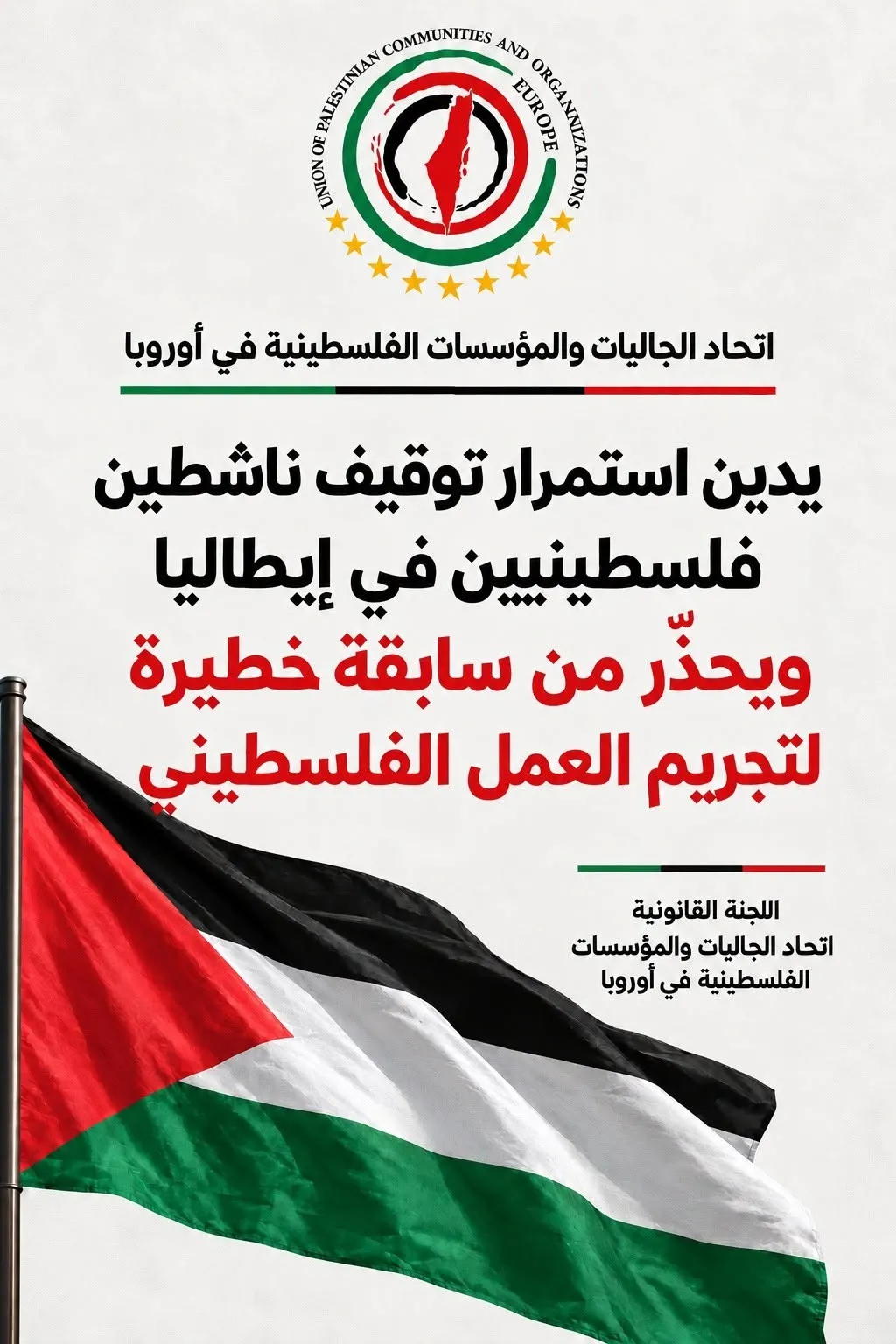
Palestinian institutions in Europe warn of prosecution of activists and criminalisation of Palestinian work
The Union of Palestinian Communities and Institutions in Europe has warned of the repercussions of the continued detention of Muhammad Hannoun and Raed Dawood in Italy in a case related to fundraising for Gaza.
FiMED Follow-ups
The legal committee of the Union of Palestinian Communities and Institutions in Europe has warned of the repercussions of the continued detention of Palestinian activists in Italy against the backdrop of charges related to fundraising to support the Palestinian people in the Gaza Strip, considering that the case could set a precedent threatening Palestinian work and solidarity with it in Europe.
The committee's position came following the Italian Court of Cassation's ruling issued on 9 October 2026, rejecting the appeals submitted to end the precautionary detention of the activists Muhammad Hannoun, aged 64, and Raed Dawood, aged 52, according to the union's statement.
The case involves 25 people
The statement explained that the investigations include 25 people, four of whom remain in detention, including Hannoun and Dawood, over charges brought by the Italian public prosecution regarding the transfer of donations collected for the relief of Palestinians to institutions it said were linked to Palestinian parties.
According to the legal committee, the prosecution based its charges on documents from Israeli intelligence agencies, noting that the Court of Cassation considered them unusable in judicial proceedings for failing to meet transparency requirements. Nevertheless, the court rejected the appeals concerning the termination of the precautionary detention, according to the statement.
The union indicated that a preliminary hearing is expected to be held before the end of this year, warning of the possibility that the defendants' detention could continue for a long period that might extend, by its estimates, until mid-2028.
Fears of widening prosecutions in Europe
The legal committee considered that the case raises fears about the use of anti-terrorism legislation and security classifications in prosecuting fundraising and solidarity activities with Palestinians, and said that the continued detention of the activists, despite what the statement mentioned regarding the court's position on the intelligence documents, raises questions about the legal and procedural guarantees available to the detainees.
The committee added that the prosecutions are taking place at a time when humanitarian needs in the Gaza Strip are worsening, stressing that supporting Palestinians and providing aid to them requires expanding relief and solidarity efforts.
The union warned that the case could leave effects extending beyond the defendants themselves, to affect the work of Palestinian communities and institutions in Italy and other European countries, and impact their ability to organise humanitarian, political and solidarity activities.
It stressed, according to the statement, its rejection of linking work for Palestine to terrorism files in a way that could lead to the criminalisation of solidarity activities and the defence of Palestinian national rights, foremost among them liberation and self-determination.
Demands for the release of the detainees and guarantees of their rights
The legal committee demanded the release of Muhammad Hannoun, Raed Dawood and the rest of the detainees in the case, and an end to the prosecutions it sees as targeting Palestinian activity, while guaranteeing the legal and procedural rights of all those covered by the investigations.
It also called on human rights organisations, political parties, trade unions and solidarity movements in Italy and Europe to act to follow up on the case, and to work to protect the right of institutions and communities to carry out their humanitarian and political activities within legal frameworks.
The Union of Palestinian Communities and Institutions in Europe affirmed, at the conclusion of its statement, the continuation of its efforts to defend Palestinians and their institutions on the European continent, and to coordinate work with human rights and solidarity bodies to confront what it described as attempts to criminalise Palestinian activity.