
The displacement machine: how Israel is turning Gaza and the West Bank into places that push Palestinians out
A FiMED special report tracks the mechanisms of displacement in Gaza and the West Bank in 2026, from demolition, eviction and confiscation to displacement orders, settler violence and restrictions on movement and water.
FiMED – Special Report
Displacement does not always require trucks forcibly carrying people off their land. Sometimes it begins with the demolition of a home, then the road is cut, the land confiscated, access to water blocked and the village encircled by settlements, until returning to the original place becomes harder than staying somewhere else. This is the picture UN data paint of the Gaza Strip and the West Bank in 2026: multiple tools all working in one direction, reducing Palestinians' ability to remain in their areas and reshaping the geographic and demographic space around them. According to successive UN and human rights reports, this displacement is no longer a side effect of passing military operations but has become a goal in itself.
The UN framework: fears of "ethnic cleansing" in both arenas
In a report issued on 19 February 2026 covering the period from November 2024 to October 2025, the UN Human Rights Office explicitly voiced fears of "ethnic cleansing" by the Israeli authorities in both Gaza and the West Bank, noting that Israel's policies and practices since October 2023 have led to the mass displacement of Palestinians from most of Gaza and from growing areas of the West Bank, amid tightening control over their lives, land and geographic space. The report added that "intensified attacks, the systematic destruction of entire neighbourhoods and the denial of humanitarian assistance appear to aim at a permanent demographic shift in Gaza".
In May 2026, another UN report renewed the warning, confirming "large-scale forced displacement" in both the Strip and the West Bank, while Ajith Sunghay, head of the UN Human Rights Office in the occupied territories, warned that the rate of forced displacement in the West Bank had "reached levels unseen in decades".
First: Gaza.. when staying itself becomes a cause of displacement
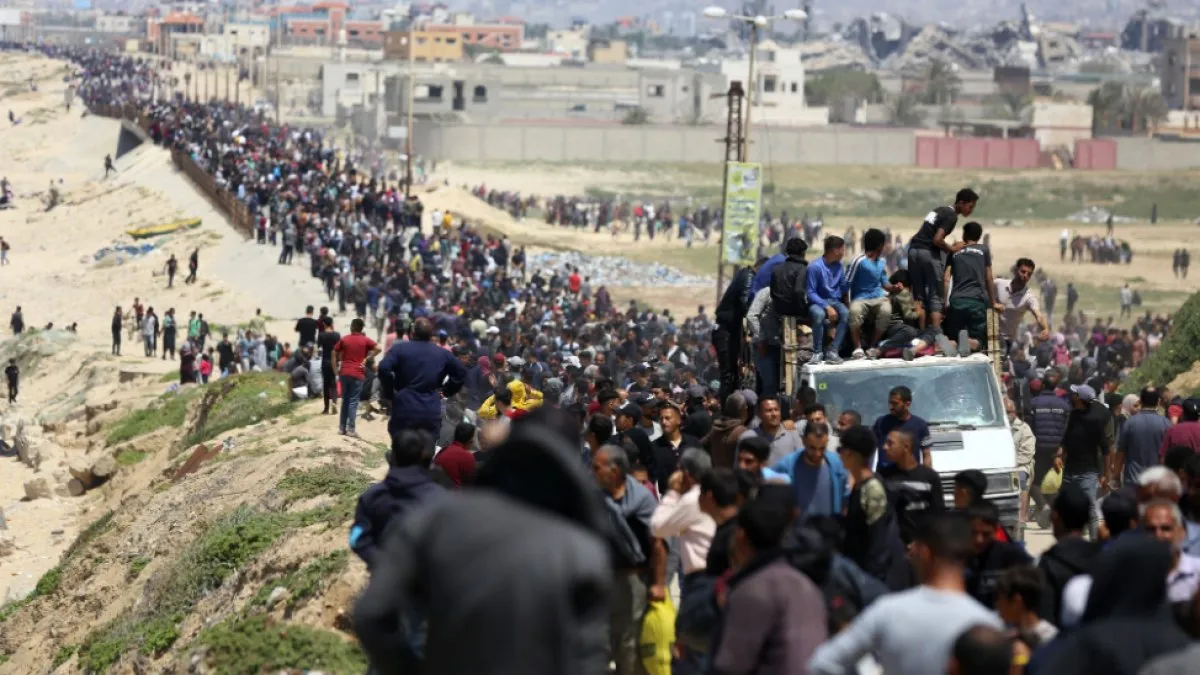
In the Strip, displacement has been widespread and repeated. Residents displaced from their areas have not necessarily found a stable place to live; instead they have faced successive waves of displacement as the lines of military operations shifted and access-restricted areas expanded. OCHA says new displacement continued during 2026, including in areas adjacent to the so-called "Yellow Line", at a time when most of the population had already been displaced from their original areas.
1. Evacuation orders and turning the map into displacement zones
Evacuation orders and military warnings are used to force residents to leave their areas within short periods, without safe, equipped alternative places necessarily being available to receive them. The UN describes this pattern as repeated displacement: families may have to leave a place, return after operations subside, and then face a new wave of displacement. Displacement is thus not a single event but becomes a continuous state of instability.
2. Wholesale destruction of shelter and infrastructure
According to official data, some 70% of the Strip's homes have been destroyed or damaged, along with extensive destruction of water and sanitation networks, basic services and cultural and religious landmarks, making residents' return to their original areas practically impossible even after military operations stop, and turning "temporary" displacement into a de facto permanent reality. Here the issue shifts from "evacuating an area" to "dismantling the conditions for returning to it".
3. Starvation and siege as a weapon
Blocking the entry of food, fuel and humanitarian aid was one of the most prominent tools of pressure, with the UN report explicitly linking "the denial of humanitarian assistance" to the aim of bringing about a permanent demographic shift. The resulting famine killed hundreds of Palestinians, including more than 150 children, according to figures from health authorities in the Strip.
4. Shrinking living space and pressure on the means of survival
The more the areas that residents struggle to reach expand, the more the space available for housing, work, farming and services shrinks. OCHA says areas under severe access restrictions, together with ongoing military operations, have deepened displacement and restricted residents' access to their livelihoods. The result is that a Palestinian may remain geographically inside Gaza but be pushed out of their original area in search of a space where they can stay, especially when displacement coincides with difficulty obtaining shelter, water, food, fuel and health care. Residents do not necessarily have to be told "leave for good"; sometimes it is enough to make the conditions for staying unbearable and let displacement do the rest.
5. Killing continues after the ceasefire
Even after the truce took effect, Health Ministry data, as cited by the Office of the High Commissioner for Human Rights, show that 631 Palestinians have been killed in Israeli military operations, keeping the sense of insecurity alive and preventing returnees from settling.
Second: the West Bank.. gradual displacement without all-out war
If displacement in Gaza is taking place amid a wide-scale war and intensive military operations, the West Bank presents a different model: gradual displacement that relies on an accumulation of tools. Demolitions, settler violence, land confiscation, court-ordered evictions, checkpoints, road closures, restrictions on water and grazing land, and settlement expansion are all factors the UN documents as direct drivers of displacement.
1. Operation "Iron Wall".. the most dangerous and most explicit tool
In a report issued on 4 September 2026 titled "Destruction of Palestinian refugee camps in the northern West Bank", the UN High Commissioner for Human Rights documented that the "Iron Wall" military operation, launched on 21 January 2025 (just 48 hours after the ceasefire in Gaza began), led to the complete forced displacement of more than 33,000 Palestinians from the Jenin, Tulkarm and Nur Shams camps, whose return is still being prevented today "in violation of international law".
The operation killed 102 Palestinians, including 21 children, destroyed hundreds of homes, cut off water and electricity and blocked access for aid. By October 2025, 52% of buildings in Jenin camp, 48% in Nur Shams and 36% in Tulkarm camp had been destroyed or damaged. The report quoted displaced people as saying they received direct warnings from Israeli officers that "there are no more refugee camps" and that everyone must leave towards Jordan. Israeli Defence Minister Israel Katz announced on 23 February 2025 that "40,000 Palestinians have actually been evacuated" from these camps and that they "have been emptied of their residents".
UN High Commissioner Volker Türk concluded that the way the operation was carried out indicates its aim was "to displace as many Palestinians as possible and make room for more illegal settlements", warning that it undermines the territorial contiguity of any future Palestinian state. Here a completely different tool emerges: keeping an area closed after its residents have left. Displacement becomes more entrenched when it is not limited to removing residents but is accompanied by the destruction of homes and infrastructure or the imposition of restrictions that prevent return.
2. Demolition.. removing the house, then pushing residents to leave
The Israeli authorities use demolition orders tied to the planning and permit system, particularly in Area C and East Jerusalem. In its report issued on 11 September, OCHA said the Israeli authorities demolished 38 Palestinian structures during the period covered by the report on the grounds that they lacked building permits, displacing 12 families comprising 61 people. Masafer Yatta and East Jerusalem also saw further demolitions over the same period. A UN report described these operations as "extensive and unlawful demolition of Palestinian homes", used as a tool "of systematic discrimination, oppression, and the imposition of control and domination".
During 2026, the number of Palestinians displaced in the West Bank by demolitions, evictions, settler attacks and related restrictions exceeded 4,000, according to OCHA, with settler attacks and access restrictions the biggest driver of displacement during the year.
3. Settlers.. a pressure tool that pushes communities to leave on their own
In herding and Bedouin areas, displacement does not require an official decision to evacuate the village; it is enough for attacks on homes to recur, property to be burned, livestock to be attacked, access routes to grazing land to be closed and residents to be threatened into leaving. OCHA says 122 Palestinian communities were fully or partially displaced between January 2023 and mid-July 2026, 47 of them emptied entirely, while the number displaced in this context exceeded 6,200 Palestinians.
In September, OCHA confirmed that more than 60% of displacement cases in the West Bank during 2026 were linked to settler attacks and access restrictions, making them the main driver of displacement during the year. Settler violence has turned from an individual phenomenon into a systematic tool of displacement: more than 3,200 Palestinians in the West Bank were displaced up to July 2026 alone as a result of settler attacks and demolitions, a rate of nearly 17 people a day, double the rate recorded over the previous three years.
4. The outpost draws closer.. and the land shrinks
A settlement outpost does not operate in isolation from the other pressure tools. When a new outpost appears near a Palestinian community, it may be followed by movement restrictions, attacks, road closures, denial of access to land and grazing areas, and even damage to water and electricity networks.
OCHA documented cases of this kind in August, noting that the expansion of outposts, threats and violence were used to restrict Palestinians' access to their land and, in some cases, to pressure families into leaving their homes.
5. Land confiscation by military order
Land confiscation continues on "security and military" pretexts, most recently the seizure of 7,498 dunams of land belonging to the town of Qabatiya in Jenin under an "immediate and urgent" military order to build a military road and a watchtower, a pattern that gradually eats away at the farmland that provides residents' livelihoods and their reason for staying on their land.
6. Arbitrary detention and movement restrictions
A UN report documented "widespread arbitrary detention, torture and ill-treatment of Palestinians", alongside a system of checkpoints and tight movement restrictions that has imposed near-total isolation on large areas of the West Bank since the outbreak of the regional conflict on 28 February 2026, cutting communities off from one another and making daily and economic life almost impossible. Checkpoints, gates, road closures and travel permits cut Palestinians off from their workplaces, schools, hospitals and farmland, and over time a place that is hard to get to and from becomes less viable for economic and social life.
7. Water.. when the source of life becomes a driver of displacement
In farming and herding communities, controlling water in practice means controlling residents' ability to stay. The UN has documented cases in which water and sanitation facilities were demolished, and others in which water supplies were disrupted as a result of attacks and access restrictions. In Bedouin and herding communities, the loss of a well or a water tank can mean losing the ability to raise livestock or farm the land altogether.
8. Targeting the camps specifically
Observers note that targeting refugee camps in particular, rather than other places, carries a political significance beyond the stated security pretext, as it targets the symbolic and legal structure of the refugee issue and the right of return by erasing the camp as a social and legal unit in its own right.
Third: Jerusalem.. displacement through the courts and demolition
In East Jerusalem, the mechanism takes a more complex form, as demolition orders overlap with eviction cases, court rulings and claims by settler groups to take control of properties. OCHA says 24 Palestinian families, comprising 93 people, were forced to leave their homes during 2026 as a result of court eviction rulings, most of them in Silwan, while some 200 families comprising nearly 900 people remained at risk of forced displacement due to ongoing eviction cases before Israeli courts. In the Batn al-Hawa area of Silwan specifically, the UN documented cases in which Palestinian families were evicted in favour of a settler organisation, in ownership disputes with roots predating 1948. Here displacement is not the result of a military operation but comes through a combination of law, the courts, urban planning and the settlement project together.
In March 2026, the High Commissioner's office said that accelerating settlement expansion and annexation across large parts of the West Bank had displaced more than 36,000 Palestinians during the period covered by its report, amid escalating settler violence and the destruction of homes and farmland.
In May, the office warned of the risk of forced displacement facing the Khan al-Ahmar community, noting that settlement plans in the "E1" area could affect 18 Palestinian communities if fully implemented.
The common denominator: displacement as a goal, not a consequence
Reviewing these tools together reveals a single pattern linking the two arenas: making staying impossible instead of issuing an explicit displacement order.
In Gaza, shelter is destroyed, food is blocked and evacuation orders follow one after another; in the West Bank, homes are demolished, land is confiscated, settler violence is unleashed and camps are raided and forcibly emptied. In both cases, the practical result is the same: gradually emptying the land of its inhabitants without bearing the direct legal consequences of a declared displacement decision.
UN reports stress that this pattern raises "serious concerns about the commission of a crime against humanity of forcible transfer of the civilian population", a crime explicitly prohibited under the Fourth Geneva Convention and the Rome Statute, regardless of the security pretexts used to justify it.
How does the "displacement machine" work?
The full picture shows that these tools do not work in isolation but as a connected chain:
Home demolished → loss of shelter → movement restricted → loss of access to land, water and work → escalating violence and threats → declining economic ability to stay → displacement → return prevented or made extremely difficult → expanded control over the land.
This is the most important point in reading the picture: displacement may be the cumulative result of different policies, and not necessarily a single declared decision to remove the population.
Gaza and the West Bank.. one model, different tools
|
Tool |
Gaza |
West Bank |
|
Military operations |
✓ |
✓ |
|
Evacuation orders |
✓ |
✓ |
|
Destruction of homes and infrastructure |
✓ |
✓ |
|
Movement restrictions and closure of areas |
✓ |
✓ |
|
Denial of access to land |
✓ |
✓ |
|
Settler violence |
— |
✓ |
|
Settlement expansion |
— |
✓ |
|
Court-ordered evictions |
— |
✓ |
|
Demolitions over permits |
— |
✓ |
|
Pressure on water and services |
✓ |
✓ |
|
Repeated displacement and denial of return |
✓ |
✓ |
Conclusion
From Gaza to the West Bank, the mechanisms of displacement take different forms, but the common denominator is the shrinking of Palestinian living space. In Gaza, this happens through war, repeated displacement, the destruction of housing and infrastructure, and access restrictions. In the West Bank, the process takes a slower form: demolition and eviction, settlements and outposts, violence and intimidation, checkpoints and road closures, restrictions on land and water, and then gradually pushing communities to leave their areas. UN evidence indicates that these factors combined are increasing displacement and weakening Palestinian communities' ability to remain where they are.
Reading displacement as merely "displacement because of war" therefore does not explain the whole picture. In parts of the West Bank, displacement happens even in the absence of all-out war, and in Gaza displacement does not end simply because operations stop in an area, if homes, infrastructure and the conditions for return have already been destroyed. The displacement machine, in this sense, is not a single tool; it is an integrated system that makes staying harder, leaving easier and returning more complicated.
The accumulation of these UN reports reflects a growing shift within international institutions in how they describe what is happening, with the terms "genocide", "ethnic cleansing" and "forcible transfer" recurring in official documents. Although the UN has no direct enforcement tools, the accumulation of this kind of documentation lays a legal and political foundation for future action before the International Criminal Court and the International Court of Justice. But on the ground, the most pressing question remains: how much time will this integrated system of tools need to permanently change the Palestinian population map before any real international accountability mechanism moves to stop it?